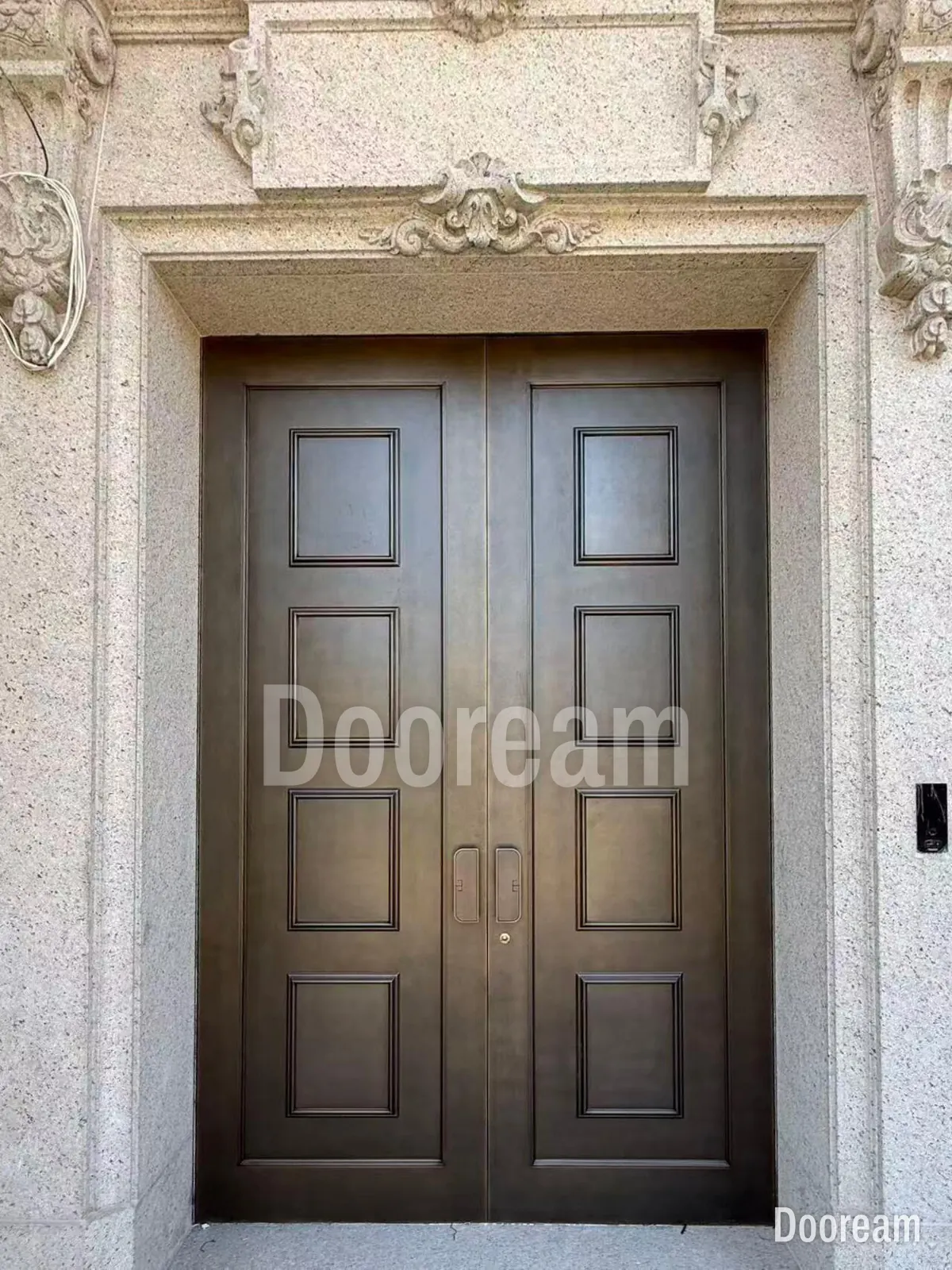
Short answer: no supplier is best for every Saudi villa. A local fabricator, a foreign brand’s distributor and a factory-direct import can each be right. Choose the one that can build your door to the drawing, give the importer complete SABER documents on time, show test evidence for what your consultant specifies, and name who installs and services the door.
How do I choose a luxury entrance door supplier in Saudi Arabia?
Start from the door, not the supplier: the opening sizes, how many entrances the villa has, the city’s climate and the date the door must be on site. Then ask each supplier to show in writing that it can make that door, document it for Saudi rules, deliver it on that date and stand behind it after installation.
We make doors ourselves, so we rank no one. General supplier questions are in our Dubai guide, sizes and door types in villa entrance doors in Saudi Arabia and the UAE.
Which kinds of supplier can a Saudi villa use?
Three, and projects often mix them: a local fabricator or showroom, the Saudi distributor of a foreign brand, or a factory abroad selling direct to your dealer or contractor. In Saudi Arabia the key difference is often who imports the door, because that company deals with SABER.
| Local fabricator or showroom | Distributor of a foreign brand | Factory-direct import | |
|---|---|---|---|
| Good at | Site visits, repairs, quick changes | A known system, local stock, service | Your drawing, from one door, in sizes and faces no catalogue offers |
| Lead time | The workshop’s queue, plus any parts it imports | Short for a stock model; factory time plus shipping if not | Production, sea freight to Jeddah, clearance, the land leg |
| SABER | Ask how its doors meet SASO’s rules and who imports its bought-in parts | The distributor, as importer; ask whether its certificate covers your model and size | You, your dealer or contractor, as importer, with the factory’s product documents |
| Main risks | Bought-in parts with no test reports; a face it cannot make | A size or face outside the brand’s range or certificate | Late documents holding a finished door; a crate too big for the route |
| What to check | What it makes itself; a finished door to try | Test reports for a door as big as yours; local spares | Document list and date; a dated programme; the installer |
Settle the importer before you order factory-direct. A foreign factory cannot register the door: the International Trade Administration notes that SABER can only be used by importers, SASO-approved certification bodies and Saudi customs.
What does Saudi Arabia add to the choice?
Four things: certificates for an imported door, the Saudi Building Code, the route into the Kingdom, and a climate that runs from dry heat in Riyadh to humid coasts at Jeddah and Dammam. Each favours a different kind of supplier.
SABER. Before shipment, the importer needs a product certificate of conformity, valid for one year and charged per model, and a shipment certificate for each shipment. Steps, labels and duty: our SABER import guide.
Saudi Building Code. The SBC applies to all construction work, public and private; residential buildings came under it on 1 July 2021, and all building types by 18 July 2023. For an entrance door, ask about the 2018 Saudi Energy Conservation Code (SBC 601–602) and the Saudi Residential Building Code (SBC 1101–1102). Ask your consultant which clauses and test evidence the permit needs, then ask each supplier for reports on a door of your size, and, if none exist, who pays for a test.
Route. The main gateways are Jeddah Islamic Port on the Red Sea and King Abdulaziz Port in Dammam on the Arabian Gulf. Maersk’s Middle East Operational Update 55, of 18 November 2026, says Saudi import cargo, including cargo for Riyadh and Dammam, continues to move through Jeddah and on by land. Out-of-gauge cargo, too big for a container, is open to Jeddah only on a limited basis and suspended to Dammam, Al Jubail and King Abdullah Port. Confirm the booking for a tall pivot door crate before production.
Climate. Britannica notes summer shade temperatures above 38 °C in almost all of the country, and low humidity except along the coasts, where it can be high.
| City | What the door faces | Ask the supplier for |
|---|---|---|
| Riyadh | Long, dry summers; dust storms, most often in April | How the leaf resists bowing in sun; continuous seals and a drop seal; the lock’s temperature range |
| Jeddah | Heat and coastal humidity, about 65% on average over the year | The finish and its tests; corrosion-resistant hardware and fixings; sill drainage |
| Dammam and Al Khobar | Gulf-coast heat and humidity, in the region with the most dust storms | Both: coastal finish and hardware, dust seals, a protected cylinder |
Jeddah’s monthly mean humidity ran from 44.5% to 68.0% in 2016–2020 (Bawadekji and colleagues, 2022). Albugami and colleagues (2019) found dust storms peak in April in most regions, and the east has the most, 10 to 60 a year. More: hot climates, sand and dust, coastal finishes.
How do style and privacy shape the order?
The architect’s design sets what the supplier must make, and two Saudi points matter most: the regional style of the façade, and how many entrances the villa has. A catalogue-only supplier may fit neither, so ask early for a face made from your drawing and for every external door in one quote.
Regional style. The Saudi Architecture Characters Map, launched on 16 March 2025, sets out 19 styles, including Najdi, Eastern Najdi and Coastal Hejazi architecture. The National describes Najd buildings by mud brick and thick walls, and Hejaz buildings by Red Sea coral stone and the mashrabiya, an oriel window with wooden lattice screens. The exterior guidelines start with major, government and commercial projects in Makkah, Al-Ahsa, Taif and Abha; for a private villa, ask the municipality whether they apply. A Najdi façade usually suits a plain, solid leaf in a deep reveal; a Hejazi one suits lattice or geometric relief, as on our cast Lattice pivot door.
Privacy and entrances. Al-Monitor reported in 2022 that in the past “most houses featured separate reception areas with different entrances for men and women”, while newer floor plans bring everyone into one area. In a 2012 survey of villa residents in the Journal of King Saud University, 92.44% named separation between guests and residents as an attractive feature. In the traditional Najdi house, Saudipedia says, a single entrance opened indirectly onto the courtyard, with a staircase from the entrance area up to the majlis. For the supplier:
- Count the doors: guest or majlis door, family door, service door. Quote them together so faces, colour and hardware match.
- Choose the show door. It may be larger and richer than the family door, yet share one lock system.
- Plan what the open door reveals. A screen wall or a turn in the hall keeps the street’s view out of family rooms; the door cannot.

What should you check before you sign?
Use this list with every shortlisted supplier. Each line is a point where a Saudi villa project can lose weeks.
- Importer. Name it, and check it holds an import licence and an active SABER account.
- Documents. Get the supplier’s SABER document list and send date; run the product certificate alongside production.
- Model. Get the certification body’s answer, in writing, on whether your size and face count as a new model.
- Code evidence. Match each SBC clause your consultant names to a report: the test, the laboratory, the size of door tested.
- City. Give the supplier the city and the door’s exposure, and agree finish, seals and lock to suit.
- Route. Ask the forwarder for the port, the land leg, whether the crate is out of gauge, and war-risk cover.
- Entrances. Quote every external door together, with its handing, and mark the majlis door.
- Installer. Name who fixes and seals the frame and prepares the floor for a pivot; send them the drawings before shipping.
- Service. Ask who in the Kingdom answers a warranty call, and where spare parts are kept.
- The company. For an overseas factory, check it before paying a deposit, and ask for photos and video of the finished door before the balance.
How does this work with Dooream?
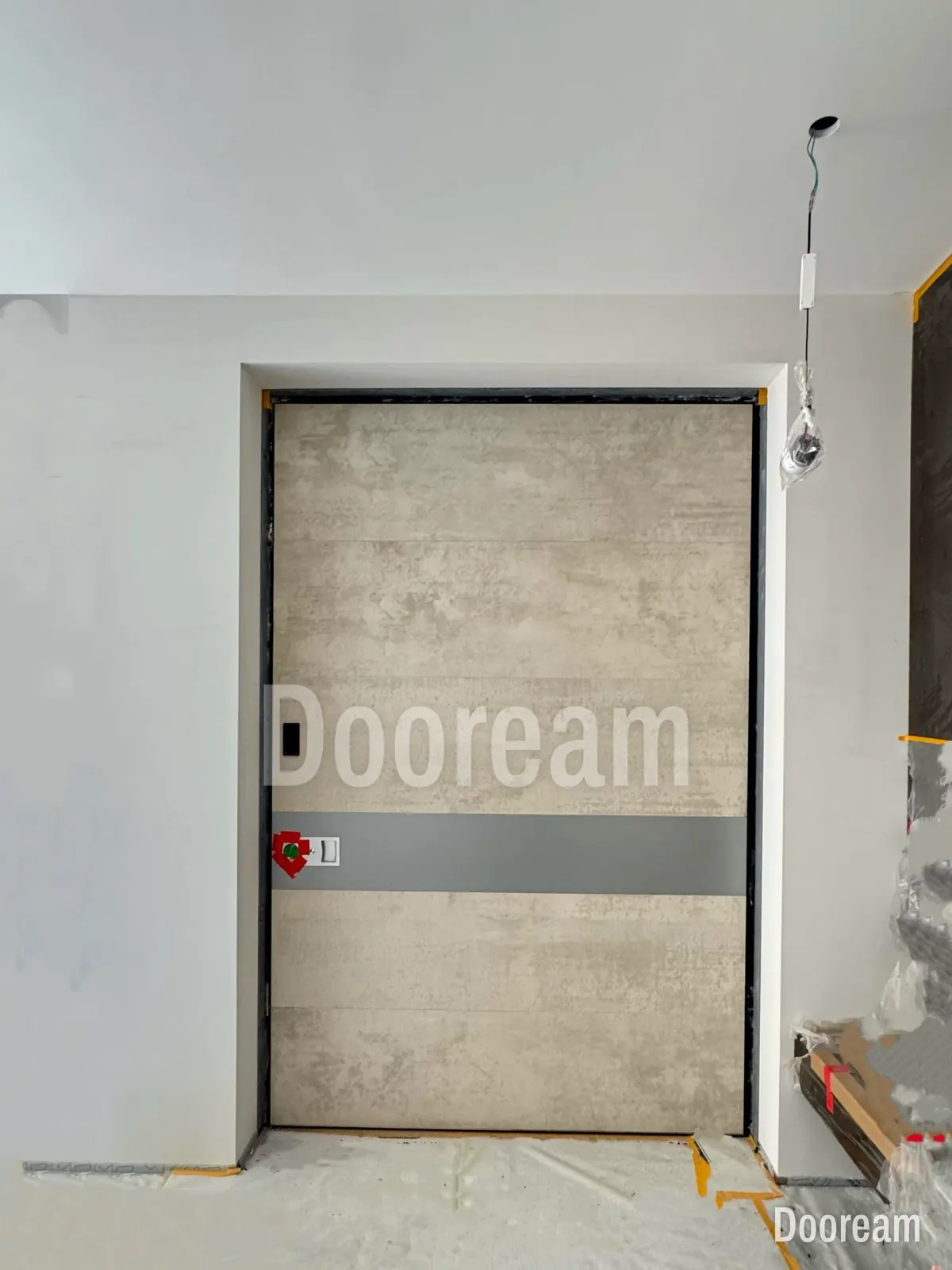
Dooream is the export brand of Zhejiang Jingyi Door Industry Co., Ltd., a family door factory in Wuyi County, Zhejiang, China: a factory-direct supplier for trade buyers. We make custom aluminium armoured entrance doors to drawing, from one door: pivot doors up to 4,000 × 8,000 mm, and double or unequal double doors up to 3,000 × 6,000 mm, such as the carved Villa Double. We supply the product documents a Saudi importer needs for SABER registration; the importer or its agent applies for the certificates. Our thermal-break construction, with PA66 polyamide insulating strips in the aluminium profiles, can be used with any of our designs; we publish no U-value for it, and where a project needs one, a test can be arranged for that order, usually at the buyer’s cost. We do not make fire-rated doors. Prices are EXW Wuyi; production takes 35–45 days after drawing approval and deposit. Your local installers fit the door with our installation drawings and remote guidance. See villa doors for Saudi Arabia and the UAE, send drawings through our contact page, or read our pages for architects and dealers.
Sources, checked November 2026: Maersk, Middle East Operational Update 55 (18 November 2026); International Trade Administration, Saudi Arabia requirements to certify imports (May 2021); Saudipedia, The National Committee for the Saudi Building Code, Saudi Architecture Characters Map, Saudi Ports Authority and What distinguishes the traditional Najdi house?; ICC, 2018 Saudi Energy Conservation Code, SBC 601–602 and 2018 Saudi Residential Code, SBC 1101–1102; The National, Saudi Architecture Characters Map (17 March 2025); Al-Monitor, A new 'architectural openness' is remaking Saudi streets (21 July 2022); R. I. Hakky, Residents' satisfaction with the villa as a housing type in Saudi Arabia, Journal of King Saud University, Architecture and Planning (2012); Encyclopaedia Britannica, Saudi Arabia: climate; Bawadekji and colleagues, Recent atmospheric changes and future projections along the Saudi Arabian Red Sea coast, Scientific Reports (2022); Albugami and colleagues, Spatial and temporal variations in the incidence of dust storms in Saudi Arabia revealed from in situ observations, Geosciences (2019).
Quick answers
Who is the best luxury entrance door supplier in Saudi Arabia?
No supplier is best for every villa. A local fabricator, the distributor of a foreign brand and a factory-direct import can each be right. Choose the one that can build your door to the drawing, give the importer complete documents for SABER on time, show test evidence for what your consultant specifies under the Saudi Building Code, and name in writing who installs and services the door.
Who deals with SABER when a villa door is imported?
The importer, which may be the distributor, a dealer or the contractor, because only importers, SASO-approved certification bodies and Saudi customs can use SABER. Before shipment it needs a product certificate, valid for one year and charged per model, and a shipment certificate for each shipment. The supplier's job is to send complete product documents on time.
Which Saudi port should an imported door go to in late 2026?
Jeddah. Maersk's update of 18 November 2026 says Saudi import cargo, including cargo for Riyadh and Dammam, continues to move through Jeddah and on by land. Out-of-gauge cargo is open to Jeddah only on a limited basis, and suspended to Dammam, Al Jubail and King Abdullah Port.