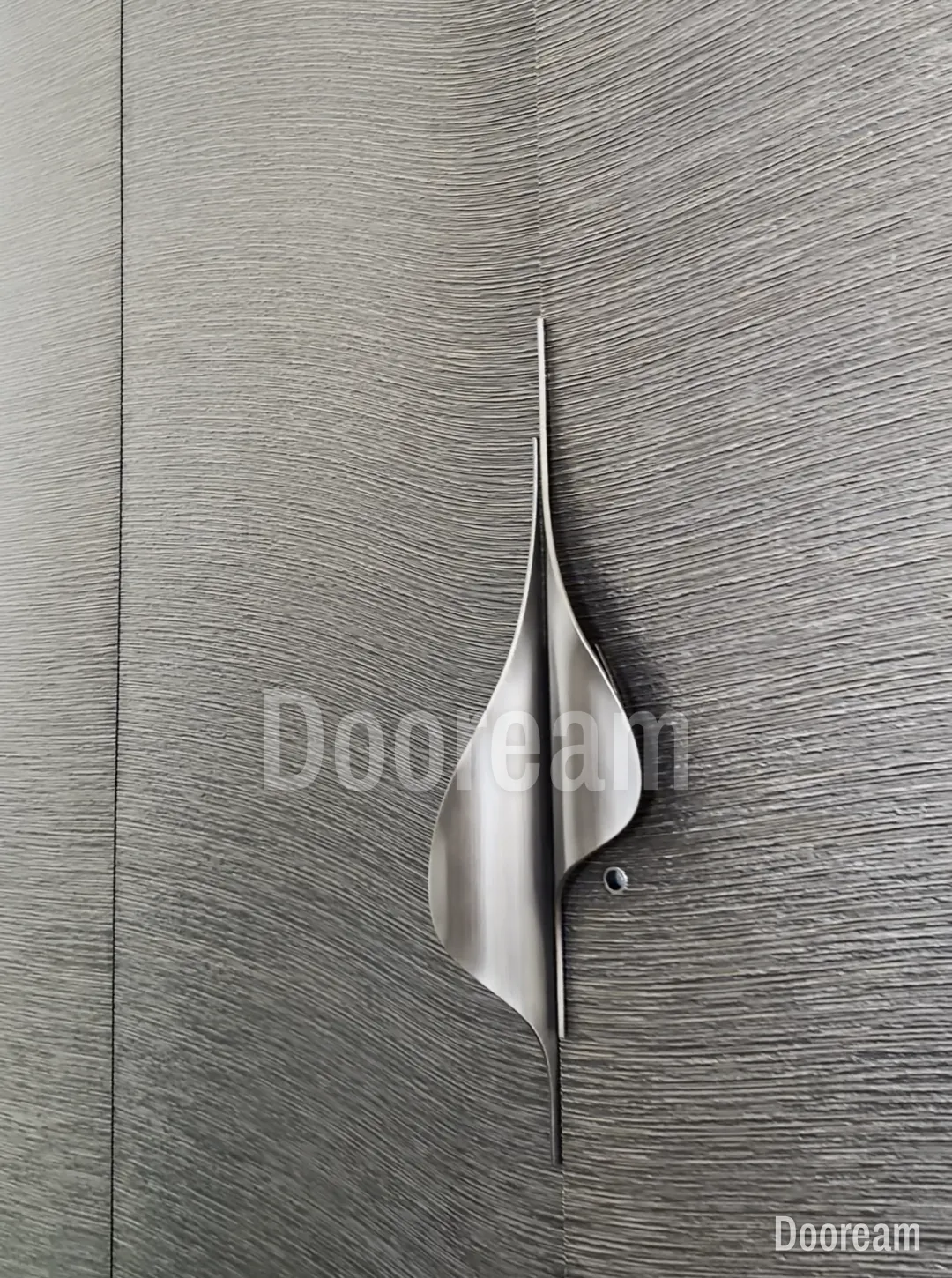
Short answer: grey entrance doors span two very different performance zones. Deep anthracite greys such as RAL 7016 and RAL 7021 give crisp dark contrast against pale stone or render, yet behave almost like black in direct sunlight and show pale dust or salt quickly. Mid-greys, brushed silver-greys and warm mineral greys (RAL 7039, RAL 7037, RAL 7040) reflect more solar heat, keep carved door relief visible from the path, and forgive desert dust and hand marks far better.
Which RAL grey should you choose: anthracite, slate, quartz or silver-grey?
“Grey” covers dozens of distinct architectural tones with warm brown undertones, cool blue-slate casts or metallic sparkle. Always specify the exact RAL Classic code, gloss level and texture rather than asking for “dark grey” or “charcoal”.
| RAL Classic code and name | Visual tone | Typical architectural pairing | Relief visibility and upkeep |
|---|---|---|---|
| RAL 7021 Black grey | Near-black with muted charcoal softness | White render, pale limestone, minimalist steel portals | Softer outline than jet black; hides minor harshness, still runs very hot in sun |
| RAL 7016 Anthracite grey | Deep slate-charcoal with slight cool undertone | Matched window frames, pale stone, contemporary concrete | Very popular frame match; shadows blend on carved faces; shows pale dust |
| RAL 7015 Slate grey | Medium-dark cool grey | Red brick, dark timber soffits, zinc roofs | Slightly lighter than 7016; keeps deeper carved flutes legible |
| RAL 7022 Umbra grey | Dark warm brownish grey | Warm travertine, sand render, bronze or brass hardware | Earthy warmth bridges stone and dark bronze pulls |
| RAL 7039 Quartz grey | Mid-tone warm taupe-grey | Desert sandstone, warm concrete, cream limestone | High forgiveness against wind-blown dust and sand; good shadow legibility |
| RAL 7040 / 7035 Window / Light grey | Pale architectural grey | Dark cladding, charcoal stone, coastal villas | Cooler in sun; reads clearly against dark façades without stark white glare |
How hot do anthracite and grey front doors get compared with black and white?
Standard dark greys absorb nearly as much sunlight as black. Because RAL 7016 Anthracite Grey carries a light reflectance value (LRV) around 4–8% depending on formulation and gloss, its outer aluminium face experiences high solar heat gain on unshaded west or south elevations.
As shown in our ASTM E1980 heat-balance calculation in black front doors, under peak 1,000 W/m² solar conditions a standard black face (solar reflectance 0.05) reaches roughly 82 °C, an infrared-reflective cool black (0.25) drops to around 73 °C, and a white face (0.80) stays near 45 °C. Typical dark greys and anthracite tones with low solar reflectance (around 0.10–0.20) sit between cool black and conventional black in full sun, creating noticeable differential thermal expansion between the hot outer panel and the air-conditioned interior face.
- Use shade or cool pigments for RAL 7016/7021. Where an unshaded doorway takes long afternoon sun, add a deep overhang (canopies and overhangs) or request infrared-reflective cool pigments with written solar reflectance data.
- Move up to mid-grey or metallic grey. Lighter greys and satin metallic coats bounce substantially more visible and solar light, reducing thermal bow stress on tall 3 m+ leaves (tall front doors bowing and warping).
How do grey shades pair with limestone, concrete, brick and timber?
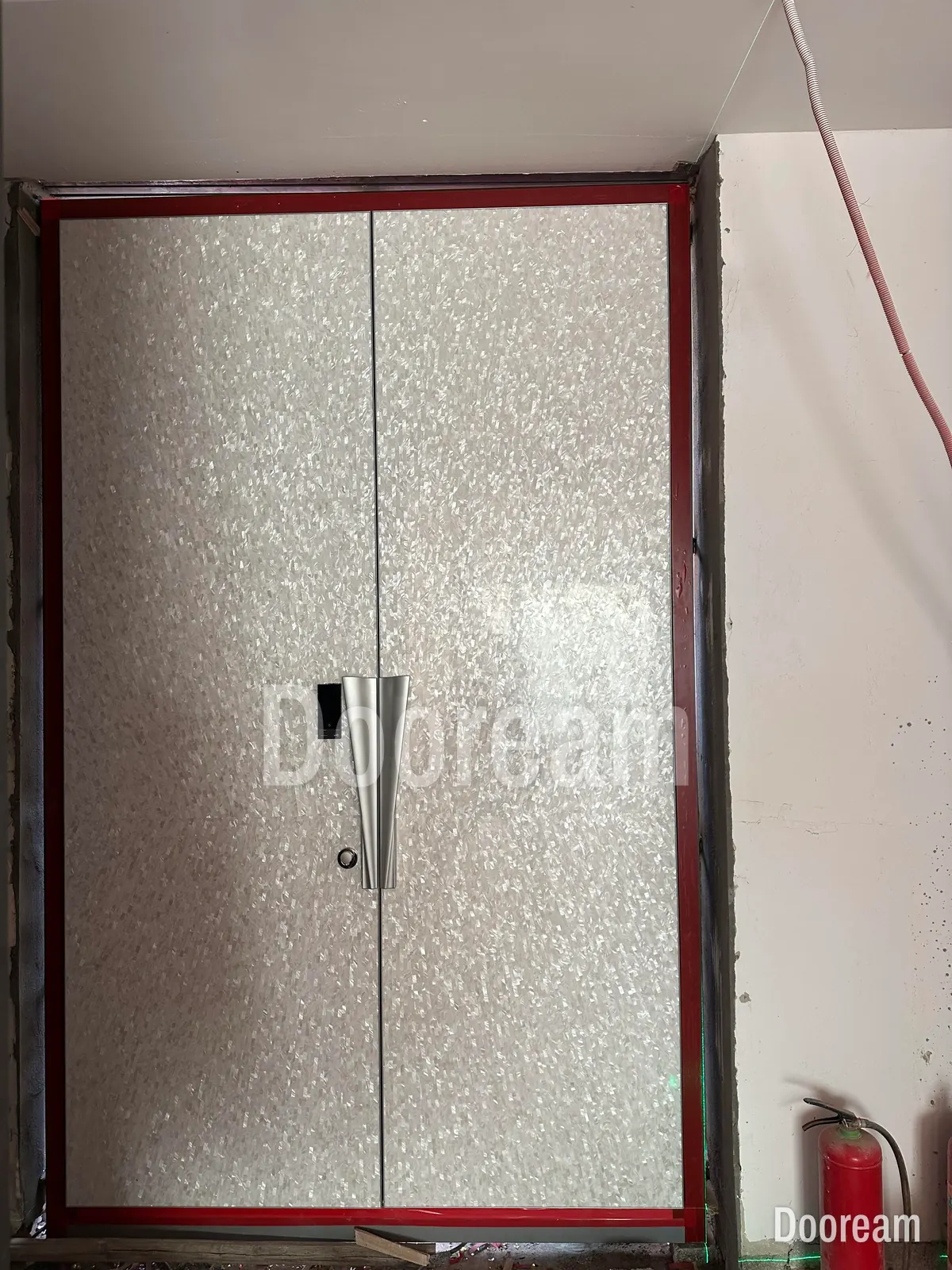
Grey works as either a quiet architectural match to window mullions or a tonal bridge between warm stone and brushed metal. Check the undertone first: cool blue-greys clash beside yellow sandstone, whereas warm umbra or quartz greys clash beside crisp blue-white concrete.
- Match window and gate frames deliberately. If your windows are powder-coated RAL 7016, matching the entrance door frame to RAL 7016 while shifting the door leaf one tone lighter (or into brushed metallic grey or warm wood tone) avoids a flat wall of identical dark plastic-looking paint (matching front door to gate and windows).
- Pair hardware by undertone. Brushed stainless steel, satin nickel and black PVD pulls sharpen cool anthracite and slate greys; brushed brass and champagne bronze warm up RAL 7022 Umbra Grey and RAL 7039 Quartz Grey.
- Keep dark grey off dark stone. Against basalt, dark slate cladding or charcoal brick, RAL 7016 disappears; step up to silver-grey, brushed metallic grey or a pale stone-tone face so the entrance reads clearly from the street (front door colours for luxury villas).
Gloss, matt or brushed metallic: which finish keeps grey looking crisp?
Avoid high-gloss on dark grey entrance doors outdoors. Under Qualicoat gloss categories (ISO 2813 at 60°), Category 1 matt (0–30 gloss units) or fine-textured metallic fluorocarbon (PVDF) hides minor surface flatness ripples, softens glare and resists visible fingerprints around the smart-lock keypad.
- Brushed metallic grey. Painted metallic grey over CNC-carved grooves catches raking light differently at every angle, making textures like our Sail double door read vividly up close without harsh reflections.
- Fine sand texture. Masks everyday hand marks and light scuffs better than smooth satin, though grooves need rinsing with clean water in dusty climates so fine silt does not turn dark anthracite grey patchy.
- Outdoor durability. For coastal or high-UV villas, specify AAMA 2605 fluorocarbon (70% PVDF, tested to 10 years South Florida exposure and 4,000 hours salt spray) or Qualicoat Class 2/3 super-durable powder coatings, plus Qualicoat Seaside pretreatment within 5 km of salt water (coastal door finishes).
Specification and sample checklist for grey and anthracite doors
- Specify the exact system code (such as RAL 7016, RAL 7021, RAL 7022 or RAL 7039), coating type (PVDF or super-durable powder) and gloss band (matt 0–30 GU or fine texture).
- Inspect a 20 × 20 cm physical sample outdoors in direct sun and deep shade beside your real façade stone, render and window-frame offcut (door samples before ordering).
- Request infrared-reflective pigment data or add a generous porch overhang if specifying unshaded RAL 7016 or RAL 7021 in hot climates.
- Keep carved relief bold or move to mid-grey/metallic tones if shadow detail needs to read from the gate.
- Coat the door leaf, outer frame and any adjacent trims in one single paint batch so metallic flakes and grey undertones match cleanly.
- Rinse textured greys periodically with pH-neutral detergent in the shade to clear salt and fine desert silt.
How does this work with Dooream?
Dooream (Zhejiang Jingyi Door Industry Co., Ltd., Wuyi County, Jinhua, Zhejiang, China) manufactures complete custom aluminium armoured entrance doors from one door—single, double and unequal double doors up to 3,000 × 6,000 mm, and offset pivot doors up to 4,000 × 8,000 mm on pivot hinges, most often FritsJurgens. Most of our doors are finished in fluorocarbon (PVDF) paint, including brushed metallic grey carved faces like Sail and dark textured models like Crystal Handle, and we can match any architectural RAL grey code with a 20 × 20 cm carved and coated sample before production. Our thermal-break construction, with PA66 polyamide insulating strips in the aluminium profiles, can be used with any of our designs; we don’t publish a U-value for it, and if your project needs one, we can arrange a test for your order, usually at the buyer’s cost. Production takes 35–45 days after drawing approval and the 50% deposit (50% balance before shipment EXW Wuyi), with installation drawings, remote guidance for your local installers and a two-year warranty from shipment. Send your RAL code, elevation and façade sample photo via our architects page or contact page.
Sources, checked November 2026: RAL, all RAL colours; PPG, FGIA/AAMA 2605 and cool coatings; AkzoNobel, Interpon D for Architecture specification guide (June 2026); ASTM E1980-11 solar reflectance index (sample pages); QUALICOAT, specifications for architectural coatings on aluminium.
Quick answers
Does a RAL 7016 anthracite grey front door get nearly as hot in the sun as black?
Yes, unless it uses infrared-reflective cool pigments. Published colour data places RAL 7016 Anthracite Grey at a light reflectance value (LRV) of roughly 4 to 8%—close to dark charcoal—so standard RAL 7016 absorbs most incoming solar energy and heats up steeply in direct sun, though slightly less than standard carbon black.
Which grey shows carved door relief best: anthracite, slate or warm silver-grey?
Mid-grey and warm silver-grey show carved grooves and relief far more clearly than deep anthracite. Because relief reads through shadow contrast, dark shades like RAL 7016 or RAL 7021 merge shadow lines into the background at street distance, whereas lighter metallic and mid-grey tones keep every carved flute legible.
Does grey hide desert dust and coastal salt better than black or pure white?
Mid-grey and warm stone-grey hide dry dust, pollen and water spots significantly better than jet black or crisp white. Very dark anthracite (RAL 7016 / 7021) behaves much like black, showing pale salt film and wind-blown sand quickly unless shaded and rinsed regularly.