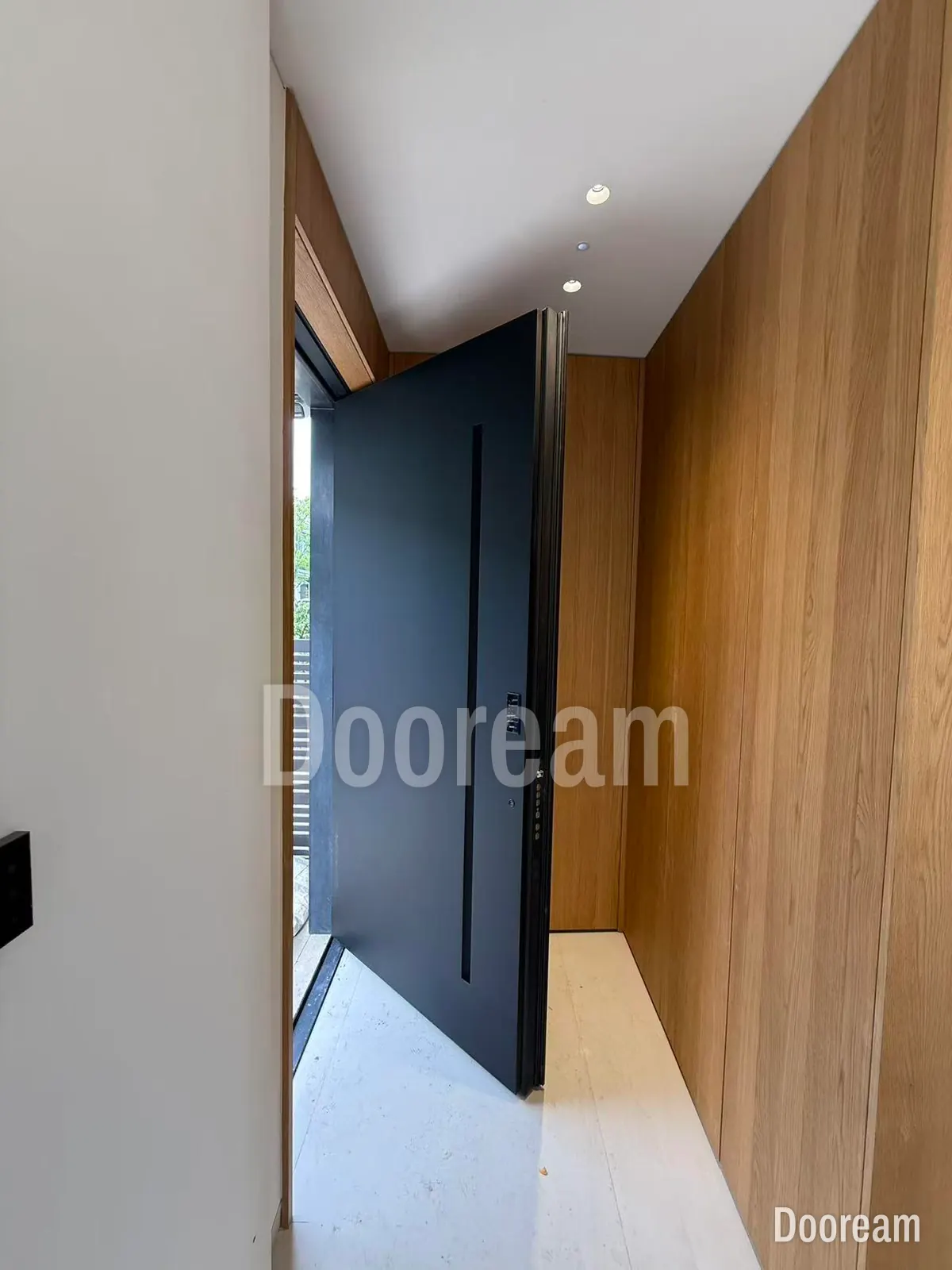
Short answer: importing custom pivot doors for a villa or residential project succeeds or stalls on five logistics and engineering checks before production begins: container door clearance for the crate, structural preparation at the floor and head, hardware serviceability and spares, local installation responsibility, and customs classification at destination. At Dooream, we build complete offset pivot doors up to 4,000 × 8,000 mm in 35–45 days after drawing approval and deposit, sold EXW Wuyi with installation drawings and remote guidance for your local installers.
Will the crated pivot door fit inside a standard shipping container?
Yes, if the crate outside dimensions clear the container door opening; if not, freight costs and routing limits change sharply. Check the actual crate dimensions—not just the door leaf size—before you finalise the elevation height and width.
Hapag-Lloyd lists the door opening of a 40 ft standard high cube container at 2,340 mm wide by 2,597 mm high, with an inside width of 2,350 mm and inside height of 2,700 mm. Because a finished door travels wrapped in blankets and foam inside a timber crate, the crate typically adds roughly 120–200 mm to leaf-and-frame dimensions depending on frame depth and pallet skids. A door set that clears 2,597 mm vertically when laid flat or tilted in a container works inside a standard 40 ft high cube, whereas wider and taller units require special equipment.
| Door and crate size | Container option | Practical implication for the project |
|---|---|---|
| Crate clears 2,340 × 2,597 mm | Standard 40 ft high cube (FCL) or LCL | Lowest freight rate; full-container factory loading avoids CFS re-handling |
| One crate edge over 2,340 mm, other under 2,597 mm | Tilted frame or split knock-down frame (confirm on drawing) | Check crate diagonal and safe tilt with factory; verify site assembly tolerance |
| Both width and height exceed high cube door opening | 40 ft open-top high cube or flat rack (out-of-gauge) | Higher ocean freight, port crane lifts, weather tarp protection and limited carrier sailings |
As documented in our shipping transit times guide, carrier operational updates in November 2026 showed out-of-gauge bookings into the Middle East were accepted only on a restricted basis. For any oversized pivot door approaching 3 m or more in both directions, confirm container fit and port acceptance with your freight forwarder during the first drawing round.
Which pivot hardware details matter most when importing across borders?
Specify a widely supported concealed pivot system and confirm exact spare parts availability in the destination country before production starts. When a door is 3,000 km or more from its factory, local servicing depends on standard components rather than proprietary brackets.
On concealed bottom-and-top pivot systems such as FritsJurgens System M+ (covering leaf weights from 20 to 500 kg across classes AA to G), the mechanism sits inside the bottom and top of the leaf, leaving only a thin floor plate and ceiling plate visible. Check four hardware details on the shop drawing:
- Rated capacity and lateral load. Confirm the calculated leaf weight sits comfortably below the hinge class limit, and pass the top-pivot lateral force to the project structural engineer.
- Cable routing for smart locks. If the project uses a hardwired motorised lock or reader in the leaf, confirm the cable pass-through diameter before the head profile is built—FritsJurgens System M+ Class G top pivots provide a 7.5 mm diameter cable entry.
- Local spares and adjustment tools. Confirm hex keys, cover plates, seal strips, cylinders and lock batteries or backup modules can be sourced locally or shipped inside the crate as a project spare kit.
- Lock and cylinder standards. Specify whether the site expects a Euro-profile cylinder or a local format so locksmiths can re-key or replace cylinders later without altering the door leaf.
For clause-by-clause wording covering pivot functions, hardware schedules and test evidence, see how to specify a pivot door.
What must the site contractor prepare before the crate lands?
A pivot door transfers its full dead weight to the floor and substantial lateral pull-and-push forces to the head. Unlike a side-hinged door that hangs from a masonry jamb, an offset pivot door requires both horizontal planes to be structurally ready before the delivery truck arrives.
- Head and lintel structure. Have the project structural engineer verify deflection limits and anchor capacity above the top pivot so the head never sags into the operating gap.
- Floor slab and underfloor heating. Locate the floor-plate or floor-box footprint from the final approved drawing before screed, stone or hydronic heating loops are laid (pivot door floor preparation).
- Finished floor datum. Confirm inside and outside finished floor levels from a single benchmark so the bottom gap and automatic drop seal operate smoothly without scraping stone.
- Lifting and access path. Large armoured leaves can weigh several hundred kilograms. Confirm crane, A-frame, vacuum lifters, corridor turns and doorway clearances from the street drop-off to the entrance opening.
- Conduit and indoor relay cupboard. Run low-voltage conduit to the frame head or adjacent wall before plastering, keeping power supplies and lock relays inside a dry, accessible indoor cabinet.
Who installs an imported pivot door, and how is responsibility split?
Nearly all export door factories supply the doorset, technical drawings and remote technical support, while the buyer’s local builder or specialist fenestration crew handles unloading, fixing, sealing and final adjustment. Do not assume an overseas manufacturer flies technicians to site unless a separate site-supervision contract is agreed in writing.
| Task | Typically handled by | Key risk if unclear |
|---|---|---|
| Shop drawing and hardware integration | Factory (signed off by architect/buyer) | Wrong handing, wrong floor datum or missing cable route |
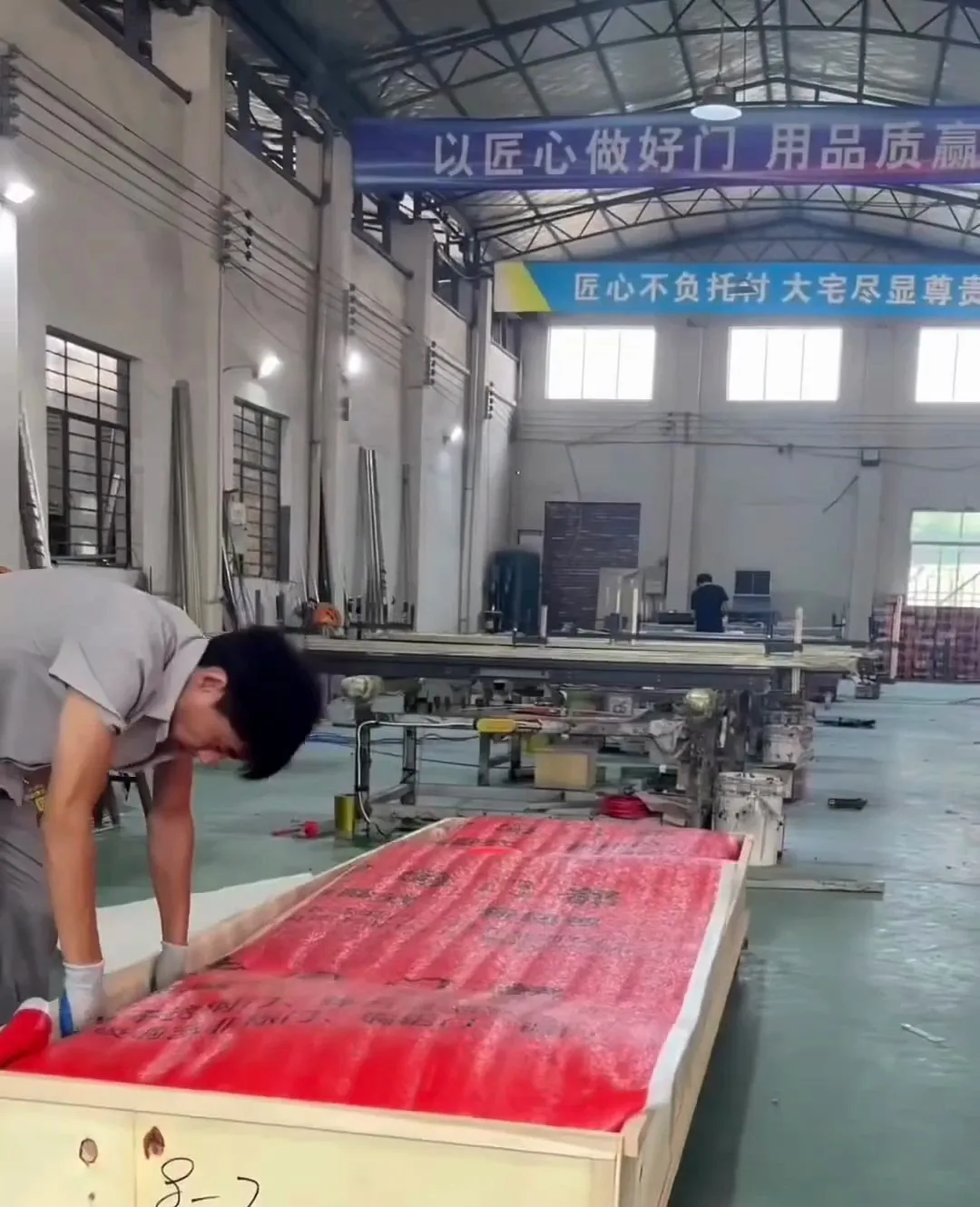
| Pre-shipment inspection and crating | Factory + buyer’s inspector | Undetected finish marks or unverified hardware functions |
| Export clearance, ocean freight, customs | Buyer’s forwarder and customs broker | Unplanned storage demurrage or missing import certificates |
| Site unloading, frame fixing, wet sealing | Buyer’s local contractor / installer | Water ingress around perimeter or twisted frame alignment |
| Commissioning smart lock and pivot damping | Local installer + electrician | Pinched lock cable or slamming leaf on handover |
Give your installer the factory’s installation checklist and schedule a pre-installation video check if it is their first heavy offset pivot unit.
What customs, tariff and compliance checks come before the deposit?
Ask a licensed customs broker in the destination country to verify the HS code, landed duty, anti-dumping scope and any mandatory local building rules before paying the production deposit. Manufacturing a bespoke door takes weeks, and non-compliant import paperwork discovered at port is expensive to fix.
- Customs classification. Aluminium doors and frames commonly enter under HS 7610.10, while steel-framed units may fall under HS 7308.30 depending on primary material and national tariff rulings. Confirm the exact tariff line with your broker.
- Anti-dumping scope. Certain countries—notably the United States (case A-570-967 on Chinese aluminium extrusions) and Australia (case 691 on certain aluminium products up to 3.0 m)—maintain anti-dumping measures whose product exclusions depend on exact door construction, glazing and height. Always obtain written broker or legal advice on whether your specification falls inside or outside scope.
- Import filings and timber packing. Verify ISPM 15 heat-treated timber crate stamps, pre-arrival filings such as US Importer Security Filing (19 CFR 149.2, due 24 hours before vessel loading), or Saudi SABER product and shipment certificates (Saudi SABER guide).
- Local building standards. Check whether your local authority requires energy U-value data, wind/water test reports, bushfire ratings or security test evidence. Dooream holds no EN 1627 rating, makes no fire-rated doors, and holds no US, Canadian or Australian certification; third-party lab testing can be arranged for a specific order, usually at the buyer’s cost.
Project import checklist before signing off drawings
- Confirm leaf size, frame depth and outside crate dimensions against a 40 ft high cube door opening (2,340 × 2,597 mm) or quote flat-rack/open-top freight early.
- Lock handing, pivot offset, finished floor levels and head structure calculations on one numbered drawing revision.
- Verify pivot hinge class, lock power route, cylinder type and local spare parts availability.
- Obtain a written tariff, duty and anti-dumping check from your customs broker for the exact HS code and door build.
- Confirm whether local building control requires any project-specific test report before deposit payment.
- Appoint your freight forwarder during production and book pre-shipment inspection before paying the 50% balance.
- Confirm the local installer, lifting equipment and wet-sealing details before the shipment arrives at port.
How does this work with Dooream?
Dooream is the export brand of Zhejiang Jingyi Door Industry Co., Ltd. in Wuyi County, Jinhua, Zhejiang, China. We manufacture complete custom aluminium armoured entrance doors from one door, with OEM available: offset pivot doors up to 4,000 × 8,000 mm (fitted with pivot hinges, most often FritsJurgens) and double or unequal double doors up to 3,000 × 6,000 mm, paired with KFV, G-U or Wintech smart locks. Our thermal-break construction, with PA66 polyamide insulating strips in the aluminium profiles, can be used with any of our designs. We don’t publish a U-value for it; if your project needs one, we can arrange a test for your order, usually at the buyer’s cost. Production takes 35–45 days after drawing approval and the 50% deposit, with the 50% balance due before shipment EXW Wuyi. Every door ships in blankets, foam and a wooden crate with installation drawings, remote guidance and a two-year warranty from shipment. Send your project door schedule and port destination through our architects page or contact page.
Sources, checked November 2026: Hapag-Lloyd, 40' standard high cube container specifications and 40' open top high cube; FritsJurgens, System M+ technical data; Maersk, operational status (Middle East operational updates); eCFR, 19 CFR 149.2 Importer Security Filing.
Quick answers
What should I consider first when importing pivot doors for a project?
Check five practical limits before you approve shop drawings: whether the wooden crate passes a 40 ft high cube container door (2,340 × 2,597 mm on Hapag-Lloyd's specification), what the pivot system needs in the floor and head structure, who will fit the door on site, which HS code and duty or anti-dumping rules apply, and the total timeline including production (35–45 days at our factory) and sea freight.
How do oversized pivot doors ship if they do not fit a standard container?
A crate taller or wider than a high cube container's door opening must go in an open-top container, on a flat rack, or be designed with a knock-down frame shipped flat beside the leaf where the system allows. Out-of-gauge containers carry higher freight and port handling charges and face restricted acceptance on some Middle East routes.
Do overseas door factories send crews to install imported pivot doors?
Usually not. At Dooream, your local contractor or specialist installer fits the door using our installation drawings and remote guidance. Confirm who unloads the crate, places the floor plate or floor box, fixes the frame and adjusts the pivot before you order.